Elmswood, No 26 Lathbury Road
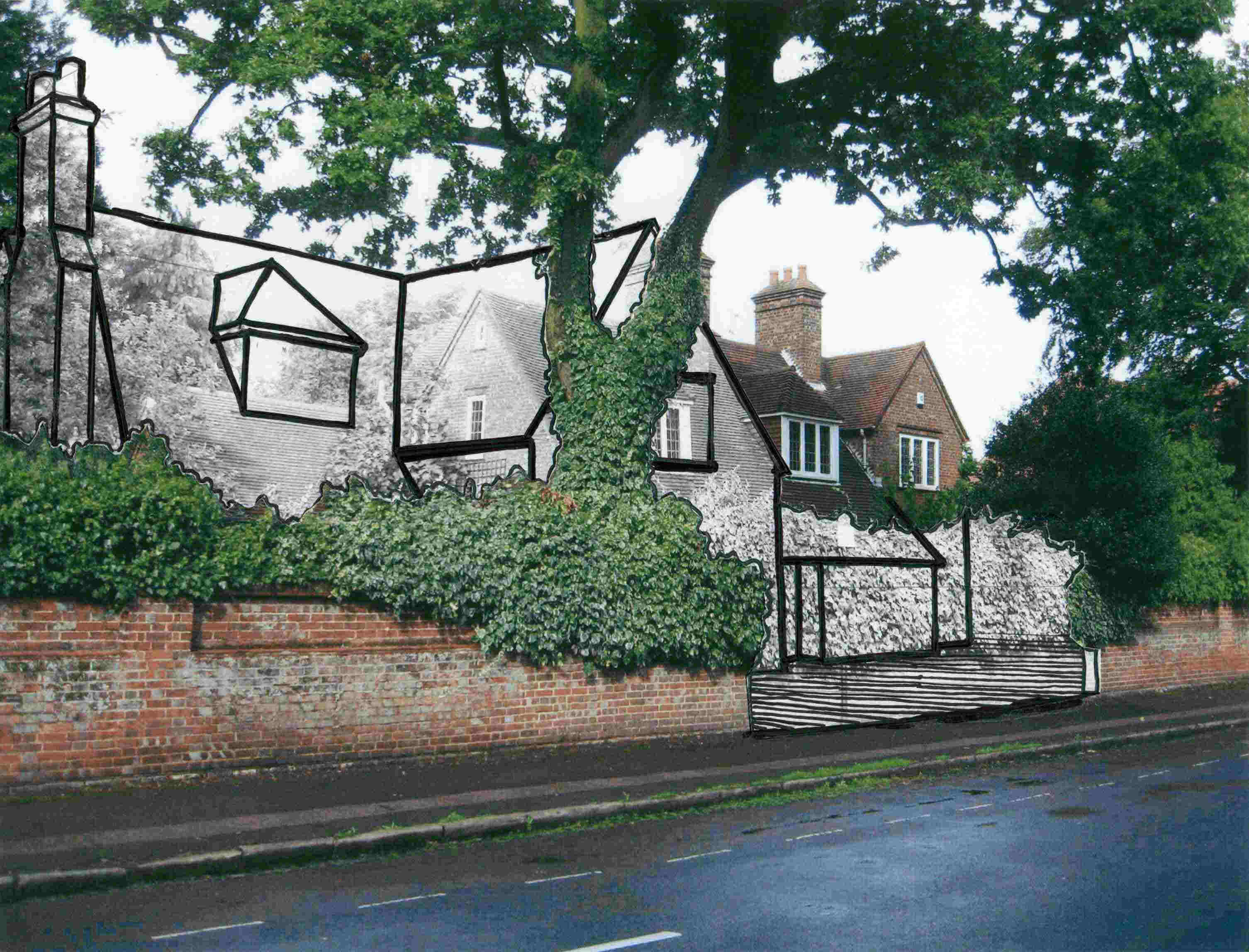
The rejected development proposal inserted
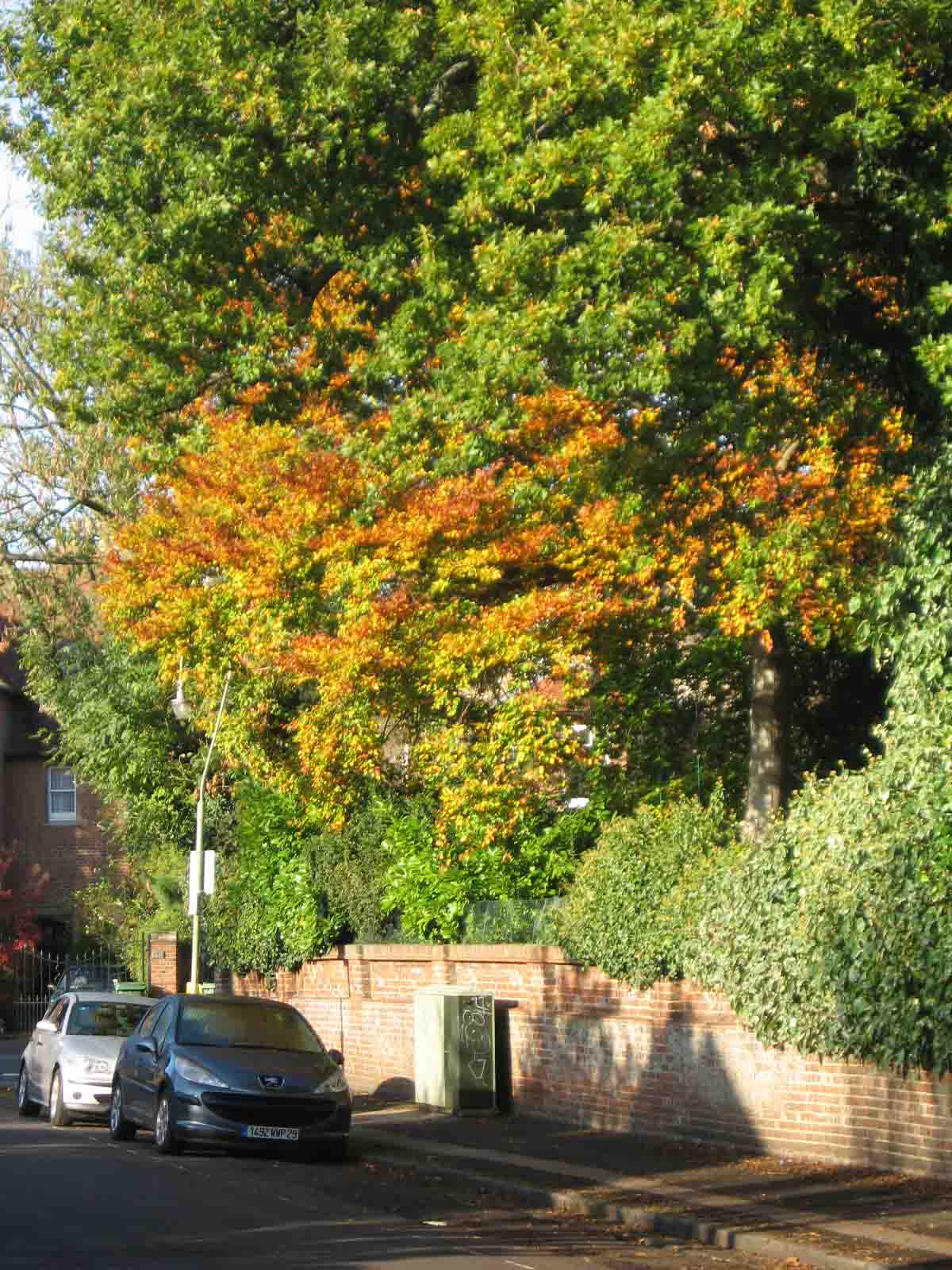
The trees on Lathbury Road
Page 6 (Click here for other pages)
Learned Societies' and Associations' submissions
Lathbury Road Residents Association
Victorian Group of the Oxfordshire Architectural and Historical Society
Linton Road Neighbourhood Association
Moreton Road Residents Association

Demolition of existing 2-storey side and rear extensions. Erection of new 2-storey front and side extensions. Two rear dormer windows and other external alterations. Subdivision of extended dwelling to form one 3-bed dwelling and one 4-bed dwelling. New access and parking area.
This property is an important element in the North Oxford Conservation Area, and a unique and charming example of the early twentieth century arts and crafts style of architecture. It was designed by a distinguished architect and has an interesting history and associations. The house is complemented by a fine garden setting, within red brick garden walls with an arched entrance. Internal alterations, and extensions to the north and east, have not been extensive enough to destroy the character of the house, especially as seen from Lathbury and Woodstock Roads. It is not too large to be practical and desirable as a family home, and it fully deserves to be treasured and to continue to be used as such.
The current proposal, like the two others presented in recent years, would be really destructive. Large new extensions would alter and obscure external features of the house. Drastic internal changes would completely erase its special character. The garden wall would be breached to allow for car parking upon the front garden. The proposed division of the garden into two would inevitably result in unsatisfactory plots of very disparate sizes. Also it seems likely that in the future two further houses will be squeezed on to similarly small plots of land between No 26 and No 24.
This would not preserve or enhance the Conservation Area. Oxford would lose a uniquely charming and well-loved feature in exchange for a cramped group of undistinguished conventional houses. It is a transaction which should not be allowed to happen in a Conservation Area.
We have already written to express our profound objections to this application. We would like to add a further point regarding the parking area, as there is ambiguity about the number of parking spaces to be provided: seven seems to be suggested, whereas the description given above the alterations to the house would require four parking spaces at the most, two for each division of the house (which would be quite generous). [ Back to the top]
Lathbury Road Residents Association
The Residents Association has just met with local Councillors, and its members are grateful to have had this opportunity to express their views to the elected officers of our local Ward.
We are aware of the great number of objections that have already been made against this proposal, including the opinions of experts, learned societies and associations. There are two overriding issues and one observation which we would like to record as being raised with the Councillors at our meeting.
1. The effect of the extension of the house on the special character and appearance of the Conservation Area. It is widely held that this conservation area is of great importance to the historical and architectural heritage of the City, and that this house, particularly owing to its garden setting on all sides, makes a special and important contribution to it. We entirely agree with Professor Binfield’s assessment (his letter to the City Council of 29 September 2009) that this site is critical for the integrity of this conservation area, and that this proposed development will harm it. His conclusion is an intense and comprehensive summary, which we are pleased to endorse and adopt:
What might be called the gardenscape of a conservation area is an indispensable part of what justifies this area’s designation. The gardenscape relates buildings to each other and it defines and describes a community. Elmswood is as important to its conservation area as it is vulnerable to predatory development. The present application is as harmful as its predecessors. It deprives the existing house of its character and distinction. The implications of the proposed demolitions, subdivision, and extension – not least the new access and parking area – would make the garden vulnerable to further development because the conservation value of the site would have been wholly undermined. And if that were to happen, what price the status of the North Oxford Victorian Suburb Conservation Area? This really is a landmark case.
It is clear from Professor Binfield’s expert view, demonstrably shared by the local learned societies and many private individuals, that this application would harm the special character and appearance of the conservation area. It fails to meet the requirements of Local Plan Policies CP1, CP7, CP8, CP9, CP10, CP11, HE6, HE7, HE8, NE16 and NE17.
2. Absence of any material consideration to allow a deviation from policy . It appears that if the Council were to deviate from its own Policies, section 38(6) of the Planning and Compensation Act 2004 would render that decision unlawful unless "material considerations indicate otherwise". In its Design and Access Statement the applicant has urged the Council to accept that "the more efficient use of an existing residential plot of land ... would be in line with Policy CP6 of the Oxford Local Plan". However, this Policy must be read in the context of paragraph 2.9.3 of the Local Plan, where it states that "The appropriate density for a site will depend on the context and nature of the proposal". We suggest that the overriding consideration here is the context of the conservation area, and that an increase in the residential capacity of the site of just one bedroom (discounting that the largest now serves as a bathroom) does not provide the necessary material consideration to deviate from the proper application of the Policies already referred to.
3. Conduct of the North Area Committee Meeting of December 2008. A number of correspondents have said, and we concur, that Reason No 3, given for refusing application 08/02028/FUL, does not precisely reflect the reasons expressed orally by the Members present at this meeting. We would respectfully suggest that the third reason (as given in the left-hand column below) should have been along the lines shown in the right-hand column, which we now recommend for refusing this application; for in this respect, this application is identical to the last:
|
Reason No 3 for rejection of application 08/0208/FUL |
Suggested corrected Reason No 3 for rejection of application 08/0208/FUL |
|
The verdant setting of 26 Lathbury Road and the spaces between buildings are important characteristics of the site and its context, contributing to the character and appearance of the Conservation Area. The proposal involves the loss of a gap between the buildings and will have an adverse impact of the garden setting of the house, causing harm to the character and appearance of the Conservation Area, contrary to national guidance and policies CP1, CP8, CP9 and HE7 of the adopted Oxford Local Plan 2001-2006. |
The verdant setting of 26 Lathbury Road and the space around the house are important characteristics of the site and its context, being essential to the character and appearance of the Conservation Area. This Building of Local Interest, its garden, trees and surrounding wall, would be adversely impacted by this proposal which would also cause harm to the special character and appearance of the Conservation Area and its setting. This proposal is contrary to national guidance and Policies CP1, CP7, CP8, CP9, CP10, CP11, HE6, HE7, HE8, NE16 and NE17 of the adopted Local Plan 2001-2016. There is no material consideration in or arising out of this application that is sufficient to justify a departure from the application of these Policies. |
We understand that this application has been called in by the Members of the North Area Committee. Please include a full copy of this letter in the agenda for the meeting, rather than summarise it, so that it may be read by the Councillors.
Mr Grigoropoulos’ concern is that the lack of an express reference to the division and extension of the house opens the door to an application for costs against the Council if now a more elaborated reason is given. We do not accept this reservation, believing that reasons are effective even if expressed in general rather than particular terms.
...we had not anticipated that the Officers’ Report would misinform and therefore risk misleading the Members. To correct the inaccuracies, we request you to take account of the following points...
Victorian Group of the Oxfordshire Architectural and Historical Society
WE OBJECT STRONGLY TO THIS APPLICATION. The house is one of the most individually distinguished in the North Oxford Conservation Area. We wrote to support the application for its spot-listing in 2004, and much regret that the application was unsuccessful. We think that the decision - based solely on the fact that the house had been slightly altered - was mistaken.
The architect of the house, Percy Morley Horder (1870-1944), was rightly described by the English Heritage Inspector as 'an architect of distinction'. His father was a Congregational minister, and one of his most important works is Cheshunt College, Cambridge (1911). In 1926-9, with his partner Verner O. Rees, he built the London School of Tropical Medicine, a building which was (and still is) greatly admired. In Oxford, his most conspicuous work is the principal front of Somerville College (1933 - currently being renovated). This was much admired by H. S. Goodhart-Rendel. He did other works for Cambridge and Nottingham Universities, but was primarily a domestic architect. 26 Lathbury Road is mentioned in The Buildings of England: Oxfordshire (1974) - the entry attributed to Professor Andrew Saint.
The house was built for Bishop Ulric Vernon Herford. He had previously built 190 Iffley Road. At the Public Inquiry concerning the appeal against refusal of permission for the demolition of that house, attempts were made to suggest that he was a figure of little importance in the religious life of Oxford, but these were refuted, and we refer you to the letter of 11 October 2006 from Professor Clyde Binfield, the doyen of Nonconformist historians.
The present application proposes the almost complete remodelling of the house. It claims that the intention is 'to give the impression of an unaltered late Arts and Crafts house, set within its mature landscape garden'. The most significant words here are 'to give the impression': the result would be quite different. In order to convert it into two dwellings, the house would be very substantially altered, including the demolition of the chapel, which has particular interest because of its bishop-builder. The house would be strung out to an implausible length, and would no longer appear as a single dwelling.
The reference to the house being 'set within its mature landscape garden' is even more preposterous, considering how much of the garden is to be destroyed. G. F. Tull, in his biography of Herford (1958), describes the garden as 'a constant delight', with its fruit and nut trees, and rockery. The formal lay-out in front of the house, with the circular pool, is shown on the original City Engineer's Deposited Plan of 1913 at the Centre for Oxfordshire Studies. This would be replaced by the parking space for the new dwelling. The handsome brick wall would be breached to provide an entrance.
This house is entirely suitable for single-family occupation, and this application, like the two previous ones should be refused.
Finally, I should like to add that I was present at the meeting of the North Area Committee when the last application was refused, and I cannot understand why the reasons for refusal did not include mention of the contribution made by the house and garden to the Conservation Area. I am sure that this was intended by the Councillors. The Refusal Notice did mention the importance of the 'verdant setting' and of the spaces between buildings in the Conservation Area. These would be seriously diminished if this application were permitted. The particular importance of corner sites in the Conservation Area was emphasised in the Inspector's Report concerning 109 Banbury Road. [ Back to the top]
We have closely examined the details of this application and are aware of the previous planning history attached to the site in the recent past. 26 Lathbury Road, as one of the few good examples of Arts and Crafts architecture in Oxford and built by an important architect, is undoubtedly a building of special local interest. The division of this generous family home would entail a significant loss of character and the proposals which show the original garage site now outside the application site, so that the parking provision has to be provided within the existing garden area, would have a detrimental effect on the setting of the house and a negative impact within the conservation area.
There is clearly a market for a house such as this as an individual house and we do not share the view that just because a detached dwelling is large, it should by definition be capable or encouraged to be divided. It is an important characteristic of North Oxford and the conservation area that there are large detached houses in their own gardens and this is a splendid example of such a house.
During the now lengthy history of applications for development on this site, a number of representations have been submitted regarding the important history of this building and its architectural merit, so that we do not intend to repeat this here. It is, however, highly significant that this process has brought such a degree of attention and research to this building and it is clear that should a local listings register be prepared for Oxford, 26 Lathbury Road would be at the top of such a list. We note that local listing is high on the national agenda, being highlighted in the Government's white paper Heritage Protection for he 21st Century (2007) and the Draft Heritage Protection Bill (2008). Guidance for Local Heritage Assets is also currently being prepared by English Heritage.
We do not support the subdivision of this fine house and we urge the City Council to reject this application in order to protect the special history and character of this important building and of the conservation area. [ Back to the top]
Linton Road Neighbourhood Association
 | From our side of the North Oxford Victorian Conservation Area, 26 Lathbury Road stands out as having a charming and recessive character which is distinct from the suburban and rather more dominating approach of houses elsewhere. It is an important reminder that the Conservation Area does not have a single character and that it is the differences in architecture, placement and planting throughout the Conservation Area which give it much of its value. |
| The style of this building, with its uncompromised Arts and Crafts design in a woodland setting, is more typical of rural settings and adds a depth and interest to the Conservation Area which is not found elsewhere. |
| The building is unique within Oxford and has few peers within the Conservation Area, and the proposed development will clearly destroy much that is of value of this building. |
| It is notable throughout the Conservation Area that very few buildings retain their original surroundings, owing to the loss of railings, the inappropriate replacement of wooden fencing, the ravages of ill-advised re-pointing and the introduction of off- road parking spaces. This building stands out as a rare house which remains in its original plot with its original garden wall and gate, and these details add significantly to the value of this house to the Conservation Area, and would be much devalued were this application to be granted. [ Back to the top] |
Professor Clyde Binfield OBE, FSA
On 26 September 2009 I wrote to you about Application No. 09/01956/FUL. That application has been withdrawn, as I understand, because of a technicality, and replaced by another which remains essentially the same. This makes it, I believe, the fourth application for this site on which I have commented in three years. This letter repeats, in essence, the points which I made in my letter of 26 September.
The application concerns Elmswood, Lathbury Road, a gently characteristic Arts and Crafts House designed by the well regarded architect, P.R. Morley Horder, for a notable Oxford character, Bishop Vernon Herford. The house is characteristic of Horder's work for clients of comfortable but not excessive means, and it is characteristic of Arts and Crafts work in the well balanced relationship of house and garden. The house, though capacious, is not large and provides enviable family accommodation as it stands, in a site which is critical for the integrity of a unique conservation area.
What might be called the gardenscape of a conservation area is an indispensable part of what justifies that area's designation. It relates buildings to each other and it defines and describes a community. Elmswood is as important to its conservation area as it is vulnerable to predatory development. The present application is as harmful as its predecessors. It deprives the existing house of its character and distinction; the implications of the proposed demolition, subdivision, and extension - notably the new access and parking area - would make the garden vulnerable to further development because the conservation value of the site would have been wholly undermined. And if that were to happen, what price the status of the North Oxford Victorian Suburb Conservation Area? This really is a landmark case. [ Back to the top]
Our specialist staff have considered the information received and we do not wish to offer any comments on this occasion.
Recommendation
The application(s) should be determined in accordance with national and local policy guidance, and on the basis of your specialist conservation advice.
[N.B. On the advice of English Heritage given on 12 November 2009 by Dr Kathryn Davies, this is a standard letter written without knowledge of the advice that the City may wish to make. English Heritage do not have the resources to comment on every application, reserving it for major cases involving policy, or where there are listed buildings of Grade I or II* and where demolitions are involved; or where specific technical advice is needed and where added value in that advice can be demonstrated.] [ Back to the top]
Moreton Road Residents Association
This site is in a prominent and important position within the North Oxford Victorian Suburb Conservation Area. The house has unique architectural qualities and the whole is enhanced by fine mature trees. There must be most compelling reasons for permission to be granted to allow any demolition or extensions at this site.
The proposals to carry out partial, but significant, demolition of the house, one can only describe as vandalism. The extensions, both at the front and side, are large and out of scale with the rest of the building. Further, the inevitable loss of fine trees to provide a driveway, car parking and light for the new windows would be a tragedy and totally out of keeping with the intentions of the Preservation Area.
To maintain this nationally recognised Victorian Preservation Area it is of paramount importance to keep these dignified and beautiful corner sites (incidentally, similar to the one at the corner of Moreton and Woodstock Roads). Previous applications for developing this site have been rejected. I strongly believe this current application has no merit and should therefore, also be rejected. [ Back to the top]
This is page 6
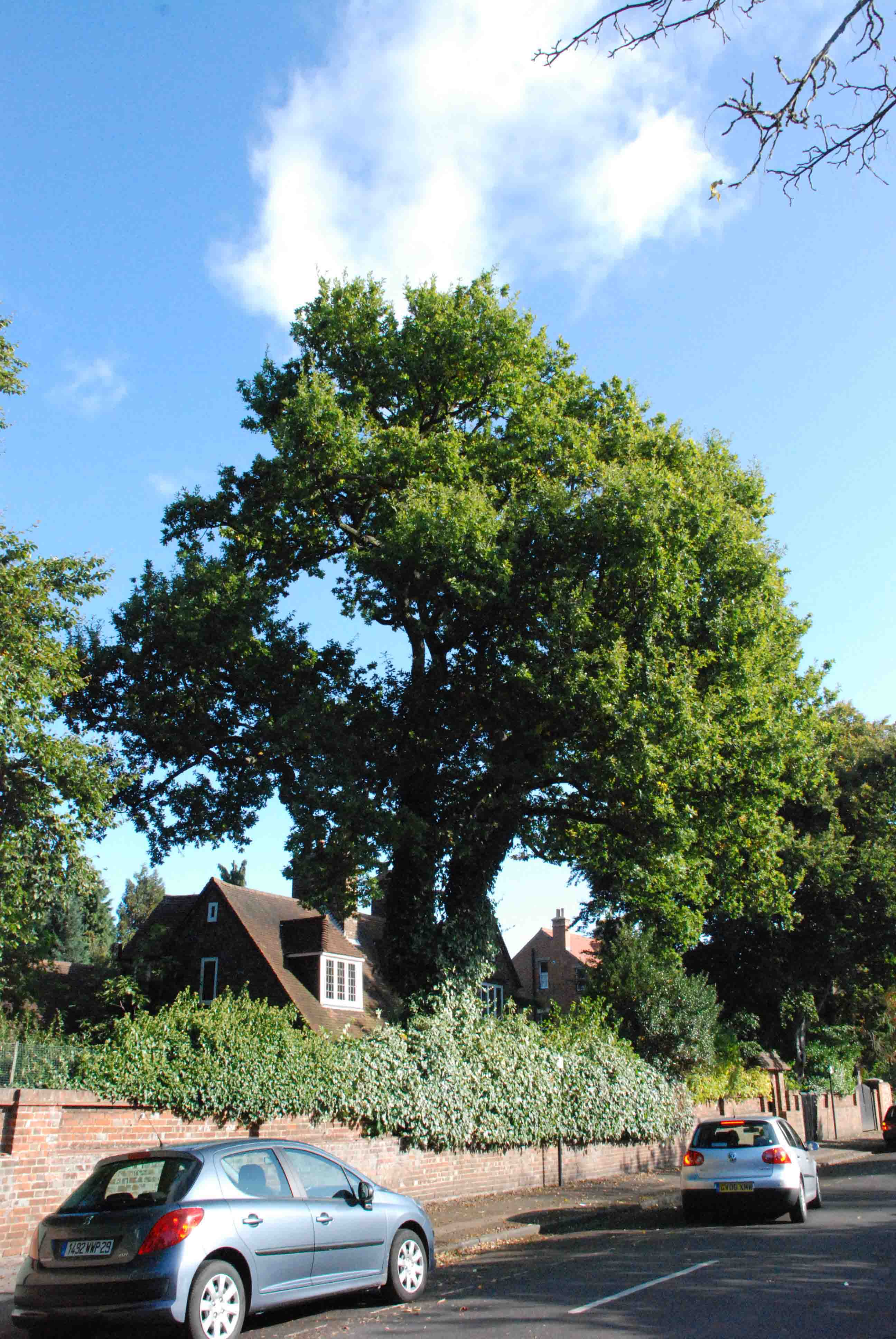
The heavily pruned oak tree on Lathbury Road
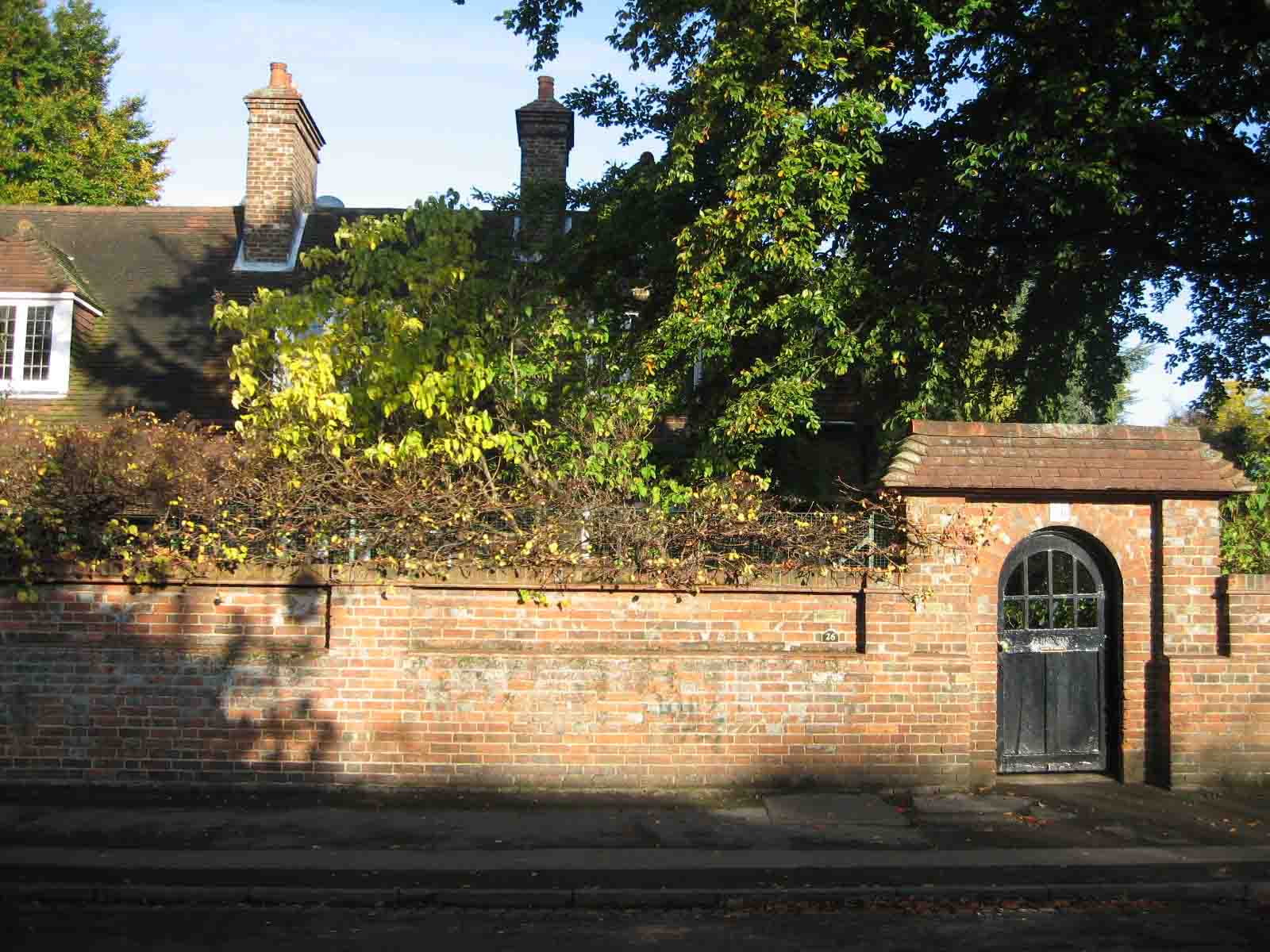
The arched gate and the roofscape
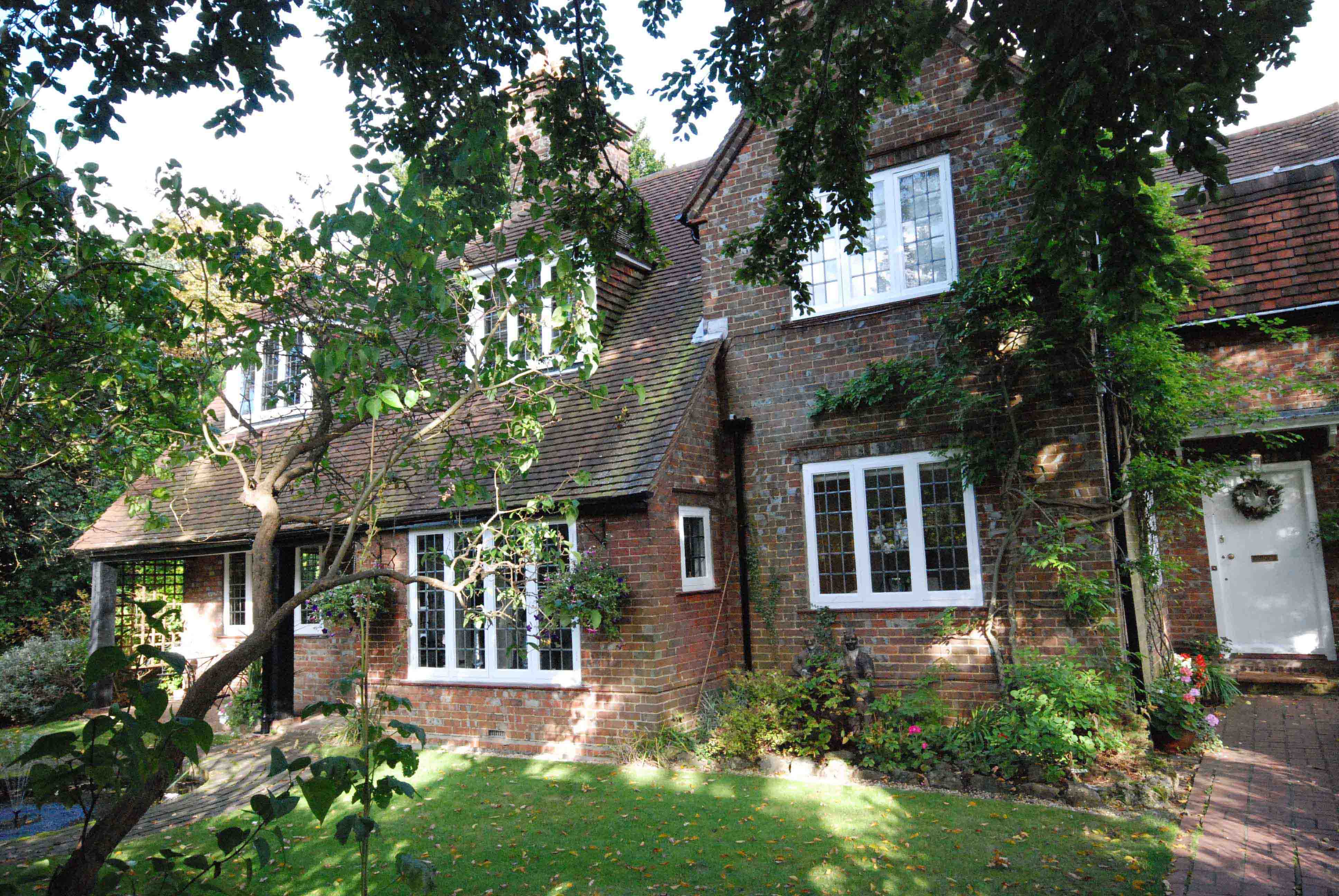
The front garden, seen through the gate, will be lost.